Showing posts sorted by relevance for query dove. Sort by date Show all posts

Thursday, November 17, 2016

Baby Dove : Johnson's Baby Soap now have a serious competition

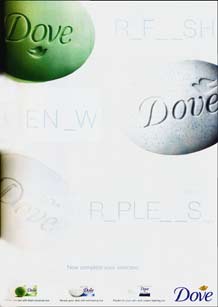
Dove, one of the premium soap brands from Unilever has extended into baby care products . The move is expected to give serious competition to the market leader Johnson & Johnson. According to ET, Indian baby care product market is worth Rs 4000 crore. Johnson & Johnson is the undisputed market leader with a share of 74%. The nearest competitor is Dabur with 9.9% share. 

Although many brands tried to break the stronghold of  J&J, none succeeded so far. Now the war has begun with India's premier marketing giant decided to challenge the market leader. Interestingly, Unilever chose to extend Dove to fight J&J.

Dove which was launched in 1993 grows from a soap brand to a Rs 1500 brand which endorses multiple categories of products. 

Dove positioned as mild soap with 1/4 moisturiser is an ideal candidate to challenge Johnson's who has incredible brand equity among the consumers. 

Dove has decided to name its extension as Baby Dove which is a smart choice. The positioning of the extension is the same as the parent Dove brand. Baby Dove was first launched in Brazil in 2015.

Another interesting aspect is the pricing. Unilever has priced Baby Dove almost the same as Johnson's but a little extra. While the 75 gm Johnson's Baby soap costs Rs 45, Baby Dove is priced at Rs 48.

Unilever already started the campaign for Baby Dove. The pitching is similar to J&J - the bonding between the mother and child, purity, skin care etc. The TVC follows the parent brand's comparative advertising strategy of testing the mildness quality of the soap with the competition.

The brand also have a different logo for the extension. The logo designed by Dew Gibbons + Partners feature the iconic master brand's  Dove and a golden baby dove besides it. 

Baby Dove has launched a series of products in the category. This include soap, lotion, skin care wipes etc.. 

With the strong distribution muscle and marketing acumen, Baby Dove is expected to give tough competition to J&J. The market with one large player dominating will definitely have space for a competitor. The launch of Baby Dove is not going to dilute the parent brand's positioning since the positioning of Baby Dove is complimentary to the parent brand. 

Saturday, July 15, 2006

Dove : The Mildest One

Brand : Dove
Company: HLL
Agency: O&M
Brand Count: 102
Dove is a $2 bn brand waiting to spread its wings in the Indian Premium soap market. Dove was globally launched in 1957. This brand came to India in 1995. Internationally this brand has a cult status and is a major player in the global premium soap market.

The brand is positioned as the Mildest Soap. Dove is PH neutral and this makes the soap soft on all kind of skin types. Internationally this brand is positioned as a brand that celebrates the " Real Beauty" . Dove defines real beauty as " beauty is not about how you look but about how you feel". The Dove's official site " campaignforrealbeauty.com" highlights this brand value. I think this is one of the best brand values a beauty product can have.

In India, the brand did not had the success of its global counterpart. One reasons are the small " Premium " market and another is the price barrier. Dove's initial price was around Rs50 that put off even the premium customers.

The brand has undergone some repositioning in recent times. Earlier the brand was positioned on the platform of " Trial for Results" idea. Later it was changed to the moisturizing platform.
The brand is claiming that it is milder than the 25 leading soaps thus proving its legitimacy to being the mildest soap in the country. Globally also this brand is positioned not as a soap but a cream bar.

Although the "Campaign For Real Beauty" and the mildness are excellent selling points, the brand is still not able to catch the fancy of Indian beauties. With lot of sales promotions happening with the brand like 1+1 free , there is a possibility of brand value erosion.With the brand now priced at Rs 28, the price has somewhat become reasonable.
I feel that still the brand does not fit into the " value for money" proposition for the Indian consumer. It is a truth that Indian consumer looks for " Value " even in premium products. Dove have a negative point in that the soap usually does not last enough ( partly because of our bathroom habits). This have reduced the value proposition for this brand.
With the emergence of an attractive market in the premium cosmetic market in India, Dove have lot of potential to become a key player, it has got the positioning right, now it has to set the " Value" right for the Indian consumer.

Sunday, June 17, 2007

Brand Update : Dove

After building its equity as one of the mildest soaps available in India and having created a small space in the premium segment of soap market, Dove has extended itself into hair care segment.Although internationally Dove has a range of hair care products, officially the range is introduced into Indian market this year.
Indian shampoo market is segmented on the basis of price. The top segment consists of premium brands like Lo'real,Garnier and other imported brands, midsegment consists of popular brands like Clinic, Sunsilk,Lakme,Head & Shoulders etc and the lower segment dominated by Sachets and local price warriors.
It is evident that the premium segment was created and dominated by Loreal and Hll feels that it should be having a brand in that segment too. Dove will be pitted against Loreal and is positioned as a premium shampoo with moisturizing properties. The presence of milk lotion acts as the differentiator. The brand takes the strength from the equity of its soap and will be trying to leverage on that strength. The brand uses the tagline " More beautiful hair with every wash" to promote the range.
The extension of Dove to shampoo is an example of brand extension. There are industry experts who say that this extension will fail because the customers can never relate Dove to haircare. I feel that for HLL Dove brand is the best bet to counter Loreal.

Related Brand
Dove
image courtesy :businessline

Thursday, July 12, 2012

Brand Update : Lux Extends to Deo

Lux, India's most famous personal care brand has extended itself to deo. The campaigns are on air featuring the extensions. The deo market in India is witnessing huge amount of brand activity with new brands being launched almost every month. According to Economic Times, the deo market is estimated to be around Rs 1300 crore and growing at 40%. 

The question as always is what can be logic behind HUL extending its iconic brand to deo. It is not that Lux is not extended before. The brand has soaps, shampoos, bodywash in the product-line. Globally this is the first time that the brand is extending to deodorants. 

HUL has been a pioneer in creating the deo category in India. The company holds its leadership position in the market with its iconic brand Axe. HUL also has its anti perspiration deo Sure and also Dove. So rather than investing on these brands why would HUL try to extend Lux into this category ? 

One of the reason can be to pre-empt competition by flooding the market with its own brands. Lux has a huge equity which will translate to trials and incremental sales. Further, the company is also wary about the launch of competing brands like Santoor, Nivea etc into this category. 
However, HUL is taking the risk of spreading the budgets too far on these extensions. After Axe, the company was not able to come out with another blockbuster deo brand. It pulled out Rexona and Sure was not able to replicate the success of Rexona ( during the initial years). Dove is also another brand which is extended to almost all imaginable personal care categories.

Lux as a brand will get more diluted  if HUL tries to milk its equity too much. None of its earlier extensions could replicate the success of the core brand. Rather than diluting, HUL could have launched new focused deo brands.

Friday, September 24, 2010

Marketing Strategy : Making Brand Portfolio Decisions


Brand portfolio decisions are strategic in nature. These decisions have very powerful impact on the entire brand architecture and marketing strategy of the firm. According to marketing theory, there are two basic brand portfolio models –House of Brands and Branded House.

Recently Rajiv Bajaj, CEO of Bajaj Auto announced a decision that the company will not be using the corporate brand Bajaj for any of the motorcycles produced by the company. Instead, the bikes will sport individual brand names and Bajaj Auto will be a garage of independent brands like Unilever and P&G. According to newspaper reports, the company will focus on four brands – Pulsar, Boxer, Discover and KTM and will not use the parent brand to endorse these individual brands. Bajaj Auto has made the decision to move from a Branded House portfolio model to House of Brands portfolio model.

House of Brands

House of Brands model refers to a brand portfolio where firms will choose different brand names for various products across categories. These brands will have own identity and personality. Different products in the same category will also have individual brand names. FMCG giants like Hindustan Unilever, P&G l follow the model of House of Brands. For example HUL has soap brands like Lux, Rexona, Hamam, Lifebuoy, Dove etc.

House of Brands portfolio model have many advantages. One of the biggest advantages is the focus that managers can give to individual brands. Since each brand will have separate identity, brand managers can devise focused strategies with regard to segmentation, positioning etc. Individual brands also give tremendous amount of freedom as far as strategies are concerned. Brand managers are not constrained in devising their strategies since the brand is not linked to any other brands in the portfolio.

Since the brands in the portfolio are independent, the failure of any one brand is not going to have an impact on other brands. Controversies affecting one brand will have minimal impact on other brands from the same company and brand managers can distance other brands from the brand which is facing the issue.

House of Brands model also have its fair share of disadvantages. Since the firm intent to have different brand names for various products, the cost of promotion of these multiple brands will be more compared to Branded House model.

In the case of House of Brands, the promotional budget has to be shared which will create internal competition among various brands for a larger share. While internal competition can be beneficial, there is also a chance of internal conflicts within the brand management teams.

Another potential disadvantage is the chances of brand cannibalization within a category. For example soap brands Rexona and Hamam from HUL compete with each other in some southern markets. Thums Up and Coca Cola compete with each other in markets where they co-exist.

If not done carefully, different brands in the portfolio can also create confusion in terms of positioning and segmentation. Overlaps in segments, cannibalization, same positioning, and clutter etc can occur if the firm is not careful about the individual brand strategy. At one point of time HLL (now HUL) found its brand portfolio with too many brands that overlapped with each other. The company had to undertake a brand rationalization exercise which reduced the number of brands from 110 to 30 power brands.

Branded House

Branded House portfolio model is where the firm chooses to have one brand name for all the products that is marketed by the company. Many firms use the corporate brand name for all the products that they sell in the market. Dell is often cited as a classic example of a Branded House.

The biggest advantage of Branded House is the economies of scale in terms of brand promotion activities. Since there is only one brand to promote, the firm can channel the entire resources more effectively.

Another advantage of Branded House is that the promotional cost of introducing new products into the market will be significantly lower compared to House of Brands. Since the new product will carry the common brand name, there is an increased chance of consumer acceptance because of the existing brand equity of the parent brand. The firm is thus spared of the task of building brand awareness from the scratch.

A major disadvantage of Branded House model is the possibility of brand dilution arising out of different products from the same brand. Unless carefully monitored, product proliferation within the brand portfolio can dilute the core positioning of the parent brand. It may not be possible for all products to have the same positioning theme and any deviation from parent brand’s positioning will dilute the core positioning them of the Branded House.

Firms strictly adhering to Branded House portfolio model may have to forego many market opportunities if those categories do not fit into the parent brand’s positioning. For example a Branded House marketing luxury product may have to forego the mass market opportunities because of the positioning constraints. That constraint is not applicable for House of Brands because the positioning of one brand may not affect another.

Another disadvantage of Branded House portfolio is the impact of product failures/controversies on entire portfolio. Since all products carry the same brand name, failure of one product can have a negative impact on the parent brand. Any controversy involving a single product can have devastating influence on the entire product range.

Although theoretically these two portfolio models exist, in practice firms tend to use various elements of both models together while devising their brand portfolio strategy.

(Reference: Tybout, A., & Calkins, T. (2006). Brand Portfolio Strategy. In Kellogg on Branding (pp. 104-129). Wiley India.)

Originally Published here at Adclubbombay.com

Wednesday, November 22, 2006

TVS Scooty : Playful + Powerful

Brand : Scooty
Company: TVS
Agency: McCann Erickson

Brand Count:162


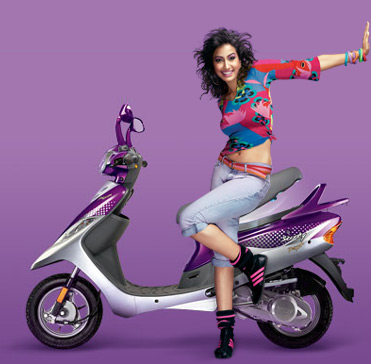
TVS Scooty launched in 1994 is one of the super brands in India. The brand has created and ruled the Scooterette market in India. Scooterettes are sub 100 cc variomatic scooters targeted specifically at the fairer sex.

The brand was an instant hit in the market because of its low price and smart positioning.The brand effectively identified the need for the TG and the product was lapped up in the market. The segment for this brand are
a. College going teenagers
b. Working ladies
c. Even Men

The market can be divided broadly into two based on the customer preference. One set of customers prefer Functionality and another segment prefers style. Scooty has been able to maintain the balance between both.
The entire market for scooters (75-125cc) is dominated by Honda with its Activa and Deo range. Scooty has a market share of about 30% in the segment. The scooterette market is hotting up with lot of competitors eyeing for the share . The latest in the block is the Hero Honda Pleasure which is positioned as a stylish brand exclusively for ladies. The competition also have prompted the players to enhance the power of the scooters.
Scooty has been consistently successful because the brand was quick to change with times.The brand never failed to emulate the competitors when they come up with added features. The brand always had two set of campaigns: one stressing style and the other stressing the functionality.

Scooty has now launched a more peppier Scooty Pep+ with more power. The engine has been upgraded to 90 cc from 75cc. The change was warranted because of the following reason:

a.There is an assumption that ladies/girls prefer less powerful vehicles. Although it is a fact that the segment prefer lighter vehicles, the " powerlessness" is just an assumption. The success of Honda is an ample proof that ladies too prefer powerful vehicle . There is also a distant possibility that the segment preference for more powerful vehicle will increase in days to come. The reason is that those who use these vehicles often need to carry either their kids or their friends along with them. Also the road conditions and the traffic calls for a powerful vehicle.Scooty aims to be the lighter powerful vehicle for them

b. Another factor is the segmentation issue. Scooty is more appealing to the college going girls because of the style. While in the case of working ladies, the segment is targeted by scooters rather than scooterettes. So unless Scooty take this segment seriously, it will be an opportunity lost for the brand. It has to be recalled that their scooter brand Spectra has failed in this market.

Scooty Pep+ is promoted heavily by TVS. The brand is positioned on the basis of Power and Style. The brand got a big boost with Priety Zinta as its brand ambassador. Priety and Scooty gels so well that I call it a perfect example of Successful celebrity endorsement ( my opinion). TVS has been lucky or smart enough in identifying right celebrities to endorse their products like Sachin and Dhoni for Victor and Star respectively.

Scooty also launched another campaign taking the brand to the next level talking about women empowerment and success. The brand is trying to ladder up to a higher state of connectedness with ladies. I think the brand has taken some lessons from Dove and Fair & Lovely which has been successful in laddering up. According to Professor Keller Laddering is the progression from attributes to benefits to more abstract values of motivations.Failure to do so will reduce the strategic alternatives to the brand. ( strategic brand management: Kevin.L. Keller).

The product category of scooterettes are showing more potential in the urban markets in coming days. This category is non existant in the semi urban and rural markets which will be a tough call and in the current conditions, it may not be possible also. The possible competition is from electric scooters and second hand Maruthi cars . Another issue for the brand is to sustain the value proposition for Scooty. Scooty is priced around Rs 32000 which is a premium. It is walking on the thin red line between benefit and cost. The price -value proposition will be biggest challenge for this brand. Having a no frill low cost Scooty has to be there to keep away the treat from the price warriors.

source: businessline,indicar, tvsscooty.com,economictimes,strategicmarketing

Monday, May 05, 2014

VWash : Creating Intimate Hygiene category

Brand : VWash
Company : Glenmark
Brand Analysis Count : # 541

After making the face and under-arms of the Indian consumers fairer, marketers are moving to uncharted territory. Indian market is witnessing the development of Intimate wash category in the Rs 1500 crore female hygiene market. This category came into public domain with the brand " Clean & Dry " from Midas Care. 

Clean & Dry with its very explicit campaign raged lot of criticisms owing to the way the brand message was executed. 
Watch the ad : Clean & Dry
The controversies helped the market to notice this category but I have a negative opinion about the way the brand executed its communication message. 

VWash is the competing brand in this category from the pharmaceutical major Glenmark.Unlike Clean& Dry, the brand has took the positoning in a much more subtle way.

Watch the ad here : VWash ad

While Clean & Dry focused on the fairness which repulsed many opinion ( also opinionated) leaders, VWash chose to take the less controversial hygiene route. VWash is positioned as a hygiene product and talks about common issues like irritation and itchiness. 
So VWash in my opinion was able to take the category out in the public domain in a much more civilized fashion than the category innovator.The health pitch would also prompt the Indian consumers to buy these products without any inhibition. 
 And interestingly the company was able to put the product displayed in prominent places in the chemists shop owing to the brand's relationship with that channel.  
Increasingly Indian market is seeing lot of new products and pitches which raises the question whether marketers are testing the " Line of Control " . Similar question marks were raised when Nivea launched the Under-arm fairness deo. But now many brands including the likes of Dove has a variant for that purpose. 
May be this category of intimate wash products may become a part of the female hygiene market in India too. 

Monday, December 19, 2016

Marketing Fundamentals : Branded Content

Concept: Branded Content is a form of advertising where the content is generated by the brand to promote itself. While it is a form of content marketing, the major difference is that the brand takes the center-stage in the content generated. It is a form of storytelling that revolves around the brand. Unlike the advertisements, branded content are more elaborate in terms of content and format. The examples of branded content are the Redbull's events of extreme stunts/sports, Amul's topicals, Dove's Campaign for Real Beauty. 
The popularity of social media has created a huge demand for content that has the power to grab the attention of the audience. While traditional content revolved around the brand, in branded content, the story is on the brand or the values that brand project. The engagement is more direct in the case of branded content. 
Application: While Harvard Business Review calls Branded Content as a digital version of content marketing, the application of branded content strategy involves more investment and involvement than the traditional content marketing. Forbes Magazine in an article suggests that the consumer engagement in branded content is much more than traditional promotional tools like ads. There is a sticky factor attached to a well designed branded content. Also, it helps the brands to move up the value that brand projects ( brand laddering). The task will be to identify meaningful stories that the brand can adopt and deliver. 


Marketing Funda Series # 1

Saturday, March 24, 2007

Brand Update : Mysore Sandal Soap

In a unique marketing move, Karnataka Soaps and Oil which markets the famous Mysore Sandal soap has gone in for creating a new super premium segment in the highly cluttered soap market. The company is launching the costliest (most expensive) soap in the Indian market Mysore Sandal Platinum. Priced at Rs 200, the soap is 4 times expensive than the current premium soap brands like Dove.

Mysore Sandal Platinum make sense for the company since it will add more equity for the existing product line. Rs 200 is quite a price for a soap but Mysore Sandal may not have volume in mind when it is launching such an expensive soap.
Now Mysore Sandal has following variants:
Mysore Sandal Soap
Mysore Sandal Classic Soap ( for overseas market)
Mysore Sandal Baby Soap
Mysore Sandal Rose
Mysore Sandal Gold
Mysore Sandal Herbal Care.
The new launch is also aimed at the overseas market. Mysore Sandal with its heritage and quality will create a good market in the west. The new brand Platinum although expensive in India will be affordable in the western market (less than $5).
In India too, the brand may adorn the super rich households. This could also have some positive effect on the Parent brand.
Along with Platinum , the brand is moving to mass market ( downmarket stretch) with a non sandal soap branded Wave. Both these initiatives can be cited as an example of Two Way stretch of a product line.

Related Brand
Mysore Sandal Soap

Source: Business standard

Friday, October 08, 2010

Marketing Strategy : The World of Experiential Marketing

Marketers are now faced with intense competition at one hand and a media clutter on the other hand. These issues are going to aggravate in the years to come. Differentiation will become difficult and if at all brands can create differentiation, communicating the uniqueness will become even more difficult.

It is in this scenario that experiential marketing becomes relevant. According to Professor Kevin Lane Keller, Experiential marketing promotes product by not only communicating a product’s features and benefits but also connecting it with unique and interesting experiences.

Traditionally, experiential marketing was appealing to those products and services that have high experience attributes. Experience attributes are those attributes which cannot be evaluated by consumers before purchase. Consumers have to experience those attributes inorder to evaluate or form opinion about it. For example, resorts, holiday packages, Spas etc are products that have high experience attributes. Marketers have to market those products/services by taking the customer through the product experience. Communicating experience attributes is one of the most difficult tasks in marketing communication.

As the consumers are moving towards an experience eco-system, marketers of all kinds of products and services should be willing to embrace the concept of experiential marketing. There are many forces that are driving this experience economy. Consumers are now exposed to a wide range of products and services. This exposure has enabled them to see beyond the marketing communication originated from the brand.

Another factor that is driving the trend towards experience is the clutter. When the product features remains the same, consumers tend to bias their purchase decisions towards those products that offer them a better experience.

Experience can happen at different levels. According to Bernd Schmitt of Columbia University, how the brands sense, feel, think, act and relate have a strong impact on the way the brands are perceived by the consumers (Journal of Marketing Management, 1999). Marketers can think about engaging with the consumers only if they are able to connect with the consumers across these five critical experience points.

In order to create an effective customer experience, marketers need to think beyond product categories. Categories are increasingly becoming irrelevant as far as consumers are concerned. Technological innovations are enabling firms to create products that transcends beyond boundaries. The focus is on the consumer’s needs and wants rather than creating a new product within a specified category.

Most of the product marketers are confused about building an experience around the physical product. How is it possible to create an experience when the consumers purchase products from retail outlets and consumes it at their own convenience?

In such a scenario, one method is to create a consumption experience in the mind of the consumer that will compliment the real consumption experience. For example, Cadbury Dairy Milk is a brand which successfully created a consumption experience in the mind of the consumer. From the product – chocolate, the brand has moved from the physical characteristics of taste and quality to a joyful experience of consuming chocolate. The recent campaign for Cadbury Dairy Milk Silk is a classic case of creating experience in the mind of the consumer.

Another method is the engage the consumers in different platforms. HUL which is India’s largest FMCG Company recently launched a website called Be Beautiful (bebeautiful.in) as a platform to communicate with its consumers. “Be Beautiful”, unlike other brand website , is a platform for all of HUL’s personal care brands like Pond’s, Lakme, Sunsilk, Vaseline and Dove to connect with the consumer. While the consumer experiences the actual products at her home, these brands try to engage consumers and shape their experience with the brand through the website. The website offers a platform for the brand to interact directly with the consumers thus create an opportunity for experiential marketing.

While marketers think too much about using the social media for advertising and promoting their products, they miss out the opportunity to engage with the consumers and create an experience in them about the brand.

Events are also a smart way of creating brand experience and to relate to the customer. Brands like Colgate uses events like “Dental Check Up Camps” to relate to the consumer. These events not only reinforce the positioning but also give a sense of relatedness to the consumers.

The cornerstone of experiential marketing is that the entire organization should be integrated to deliver the desired experience of the consumer. Philip Kotler defines Holistic Marketing as that which is based on the development design and implementation of marketing programs, processes and activities that recognizes their breadth and interdependencies. When endeavouring into experiential marketing, the entire organization should be thinking alike, be it the operations, sales, finance or HR. Brand websites which are seldom updated, complaints not attended to properly, rude sales people, unethical corporate practices can severely undermine the experiential marketing endeavour.

Originally published here in Adclubbombay.com

Sunday, February 09, 2014

TRESemme : For Salon Style Hair

Brand : TRESemme
Company : Hindustan Unilever

Brand Analysis Count : # 539

TRESemme launched in 2012 was an attempt from Hindustan Unilever to prevent the competition from attacking from the flanks. There premium shampoo from HUL was Dove which was more of a Masstige brand rather than a luxury brand. Hence HUL feels that there is a gap in the product porfolio in the premium shampoo segment which is open for competitors. Already the shampoo brands from HUL stable is facing increasing competition from Lo'real, P&G  and the likes. 

TRESemme was born in 1950. The brand name was coined in honor of Edna Emme who was a cosmetologist and a community leader.The brand came to Unilever from the acquisition of Alberto Culver in 2010.Originally the brand is sold only to salons.

The positioning of TRESemme is interesting .The brand is positioned as a salon like experience for the hair. The insight is through a research which stated that ladies feel that they get more satisfaction when they get salon treatment. Also they trust the salon stylists advice when choosing the brands.This insight made the brand adopt the USP of a 'Salon Like Experience '. The brand initially target the salon frequenting  consumers who was usually the opinion leaders in the category. 
The brand which is priced at a premium is positioning itself as an expert in hair-care. The ads are styled internationally and the message is very rational. 
Watch the ad here : Tresemme ad
The brand over the last one year also have used Youtube very effectively . The brand's youtube channel is rich with videos on hair styles and hair care thus reinforcing the positioning as a premium expert. 
TRESemme will force the competing brands to think about launching their own version of professional endorsed shampoos. Right now Lo'real and P&G have salon products which are not sold outside . It needs to be seen whether the competitors will bring in those brands to fight  TRESemme. 

Monday, May 04, 2009

Fa : Feel Good Freshness

Brand : Fa
Company : Henkel
Agency : Mudra

Brand Analysis Count : 397

Fa is one of the largest deo brand in India. The brand is from the global giant Henkel. I was surprised to know that Fa is one of the largest selling body care brand in Europe.
Fa was launched in India in 2000. The brand has a portfolio of talcs ,deos,bodywash, soap etc. It is a personal care brand endorsing multiple products.

Fa is famous in India for its range of Deos. I used to buy their unique glass bottled roll on deos that comes in various fragrances like Aqua, Lemon etc.
Despite its legacy and its international pedigree, Fa has not got the kind of respect an international brand gets.That is why the brand is still a small brand in the personal care segment compared to the brands like Lux, Ponds etc.

Fa globally is positioned on Freshness. Its global tagline is " Feel Good Freshness".

Regarding the marketing practices of this brand in the Indian market , Fa was never an aggressive player in terms of promotion or brand building. I remember a couple of ads of this brand but no memorable promotional campaigns. How ever the brand was able to create a strong association with freshness which is a strength for this brand.

Watch an ad for Fa here : Pink or Black

Most of the ads of Fa was directly imported from its parent brand's database. The advantage of foreign ads is that it creates an international image . But the biggest disadvantage is that the local connect will be lost. Brands like AXE escaped this danger but Fa failed to create a connect with the Indian consumer.

Why Axe was successful because they were talking to a globally connected younger crowd. But Fa is talking to an older crowd who do not feel connected with the brand. That is why this brand is not able to reach its potential.
Understandably this brand operates on a limited budget. Hence one cannot equate the promotinoal activities of Fa with brands like Axe. But  I have a feeling that the brand undertakes sporadic promotional campaigns rather than an organized contonuous brand campaign. 
As a consumer, it has been a long while since I came across any campaign of Fa either in print or in visual media. Henkel is a global gaint and has the money power to drive reasonable brand promotion. 
Fa had a relaunch in 2004 when the company undertook a rationalization of its product portfolio . Fa was identified as a core brand and its ad spend increased. 
Fa fights with the best brands in one of the hottest segment in the Indian consumer market. It battles the gaints like P&G, HUL and the likes. Fa also has a rich heritage and international pedigree. What the brand needs is the WoW factor and a great campaign. Dove made it to the iconic league through a great campaign - campaign for real beauty.
Fa desperately needs a break-through campaign. Freshness platform is a very relevant positioning for the brand but the brand has to utilize this platform through some clutter breaking campaign. If the brand continues to import its international campaign and continues its unorganized /unfocused media spends, the brand will at best survive in its current position. 
Fa has some good products , what it needs is some breakthrough campaigns.

Sunday, August 10, 2014

Park Avenue Beer Shampoo : Cheers to Man Hair

Brand : Park Avenue Beer Shampoo
Company : JK Helene Curtis
Brand Analysis Count : # 546

Park Avenue is a cash cow in the portfolio of JK Helene Curtis which owns the prestigious apparel brands like Raymonds , Color Plus, Parx etc. This brand has contributed half of the turnover of the apparel business of the company. Later the company decided to extend the brands to categories like men's grooming market.

According to Business Standard, men's grooming market is worth Rs 4000 crore growing at 25-30 % per annum. So for a company like JK Helene Curtis, it makes sense to extend a popular brand to this category. In September 2013, Park Avenue launched Park Avenue Beer shampoo in the Indian market.

According to ET, there is a research backup that beer is good for hair  and if Park Avenue has its way, then the most popular men's drink will find a new place - men's head ( sic).
Watch the launch ad : Park Avenue Beer Shampoo
The ad is clutter breaking and very funny. The ads were able to drive in the USP of the ingredient and isn't boring for repeated exposure. 
In this launch, the brand has done many things right. Firstly the brand has clearly differentiated itself  by its ingredient. Although other shampoo brands can launch their own version of beer shampoo, Park Avenue has virtually owned the ingredient through first mover advantage.The packaging reflects the brand's USP and the packaging is different and very smart. 
The brand has clearly communicated through its ads that men's hair is different and should be treated differently. The message is communicated through the tagline " Cheers to man hair " . The brand emphases Man Hair in the campaign to drive home the message that it needs special treatment.
So in a campaign perspective, Park Avenue has managed to break the clutter and was able to generate interest among the target group.
The challenge for the brand is to induce trial for the brand. The brand's proposition of a beer in a shampoo is intriguing and that may prompt many to try out this brand. 
Park Avenue has put this brand at the upper strata of the category by pricing it at a premium and beer justifies the premium :-)
Unlike the common practice of using celebrity, Park Avenue has gone for an Irish model Andrew Smith as the beer man ( Source ET) . 
Having said these good words, resemblance to the iconic Old Spice Mustafa campaign cannot go unnoticed. 
Last month, the brand launched its follow-up campaign  featuring the beer man. 
Watch the follow up campaign - Beer man
The second campaign however is not as good as the launch ad , may be the brand wants to take the women in the house into confidence because these purchases are often made by women. 
With many brands like Dove, Nivea, Garnier etc focusing their attention to men's grooming category, Park Avenue Beer shampoo has entered into a highly competitive market. It has done it with style . Now what has to be seen is how men reacts to beer in a shampoo .

Tuesday, June 24, 2008

Comfort : Make a Good Clothes Day

Brand : Comfort
Company : HUL
Brand Analysis Count : 333


Comfort is the new launch of HUL in the fabric care market. Although the brand was launched in early 2008, it was recently that the brand began making noise in the media. Comfort is a global brand with its origin in UK in 1969.


Indian fabric care market is huge .The numbers available in the media is confusing . Rediff puts Rs 8800 crore market size to the laundry care industry.
The fabric care market is broadly divided into three categories

Prewash : Stain removers, softners etc
Main Wash : Detergents
Post wash: Whiteners
Obviously the mainwash category is huge and dominates around 60-70% of the total market.

Comfort is initially launched its fabric softener product in India. Although the market is nascent, there is a hidden potential for such fabric care products in the urban market.
On the promotion side, the brand had just playing imported ads from the other markets
Watch one tvc here : Comfort ad

The ads are in the genre of animation /claymation and is totally out of sync with the Indian consumer's tastes. I am not sure why a company like HUL need to cut costs by importing foreign ads which are totally out of place in India.Frankly speaking , the ads does not convey any meaning and I never understood what the characters said . Hence I may not be able to speak on the positioning strategy of this brand.


The category is still emerging. The need for a fabric softener is not currently felt by Indian consumers. Especially the pre-wash treatment of clothes are new to Indian consumer. In the case of expensive clothes, consumers depend on drycleaning and for ordinary daily wear , we have taken for granted that the clothes should withstand the detergents and lasts for a reasonable time.

Hence the task of this brand is to create an awareness about the need for such products. There has been products like Bambi, and Ezee which had the softeners but failed to create a category .

Another hindrance to the category's acceptance will be the time and effort for using these products. In this fast life, do the customers have time to soak the clothes in softeners first and then wash it ? I guess no. In some cases where the clothes are pretty expensive, consumers may take the pain but in normal course, it is unlikely.

It was the reason why Unilever introduced Comfort Pearls in UK. Comfort pearls can be put in the washing machine along with the detergent and it gives the same result. It is a smart way of making the product easy to use for the consumer.

In India, the brand wants to test the market first before going all out. So initially this brand will be a niche product and I think that the category will be restricted to a niche.

But the way HUL has promoted this brand is a deviation from the usual best practices for which HUL is famous for. The company failed to take the local consumer tastes into consideration and just put some campaigns for the sake of it. There has been a trend in HUL to depend on foreign commercials fueled by the success of Axe campaigns. Lux , Rexona deo and Dove are other brands which recently started showing foreign ads. I feel that this is a unhealthy trend which can disconnect the brand from the consumer. Again and again it has been proved that Indian market needs to be addressed differently and HUL is trying to implement the plan of " One message( ad) for entire world ".
Its sad to see this from a company which talked about " Dirt is good ".

Thursday, May 15, 2008

Marketing Q&A : Brand Laddering

Marketing Practice Reader Vivek asks about the concept of Brand Laddering.

Professor Kevin Lane Keller defines Laddering as follows
"Brand Laddering involves progression from attributes to benefits to more abstract values or motivations. Laddering involves repeatedly asking what the implication of an attribute or benefit is for the customer."
According to Keller, failure of laddering up sometimes reduce the strategic alternatives available to the brand. Keller also suggests that there is a means-end chain which takes the following structure :
Attribute ( descriptive features) lead to benefits ( meaning attached to attributes) which leads to values ( enduring personal goals and motivations).
The concept of laddering has its application in positioning of the product. When the brand is launched, the focus will be more on attributes and benefits. But once these basic functionality has been established in the mind of the consumers, the brand has to deepen the meanings associated with the brand.
For example, Dove's campaign has transcended from the basic functionality of the product to " Celebrating real beauty ". Nike is all about Athletic Performance . An Indian example would be Raymonds which has transcended the basic functionality of apparels to a more deeper meaning of " A Complete Man ".
Laddering is not always easy. The task for the marketer is to first have a clear understanding of the brand's core values. Also laddering will work only if the consumers are convinced and satisfied with the basic functionality of the brand.
The advantage of laddering is that the brand will breakfree from the product restrictions. That gives lot of flexibility to the brand manager. Flexibility in extending the brand aswellas in communicating.
References
Strategic Brand Management by Kevin Lane Keller

Monday, January 15, 2007

Santoor : For a Younger Skin

Brand :Santoor
Company: Wipro
Agency: FCB Ulka

Brand Count : 189

Santoor is the second largest soap brand in the Popular segment in India. This Rs 500 crore brand comes from the Software giant Wipro. The brand was launched in 1985 as an ordinary soap with sandalwood and turmeric as its main ingredients.

The brand was initially test marketed in Bangalore and encouraged by the positive response, the brand became national a year after.The brand was positioned as the beauty + skin care at a reasonable price and the brand derived strength from the efficacy of the ingredients. At that time the brands which had sandal as the main ingredient was Moti and Mysore Sandal Soap.

The brand derived the name from combining Sandal + Turmeric and it is not from the musical instrument that it got the name Santoor.
Although the brand became popular, the company was not satisfied with the results. The customers was not buying the ingredient story : says MG Parameswaran in his book on Brands: FCB Ulka case studies. The research suggested that customers are not correlating the brand with skin care and beauty.

Thus started the brain storming on getting the " WOW " factor to build the brand. The wow factor came in the form of the new positioning " For Younger Looking Skin". The positioning come from the consumer insight that ultimately the customers look for a younger skin which is another smart way of defining beauty. The focus on " Younger Skin" also act as a powerful differentiator because other brands were focusing on "beautiful skin" or "looking beautiful".
The next big idea came in the form of communicating the " Younger Skin " concept using "Mistaken Identity " theme ( source : MG Parameswaran's Book). The brand has consistently developed this theme over these two decades of its existence.

Santoor is a brand has consistently understood the consumers and was not complacent to change. The brand was the first one to use a Mother and her five year old daughter to endorse the brand. Most of the ads showed spinsters in their campaigns while for Santoor, the protagonist were Mothers. But showing Mother as the protagonist had its share of issues also. The customers felt that since this brand is meant for adults, it will not be soft on skin. This made the company to change the size texture and the shape of the product.

In Brand Management , I used to teach that changing consumer values were one of the major forces that affect a brand. The case was true for Santoor also. Indian women's mindset were evolvingand breaking free from the traditional mindset. The Mother-daughter equation and the campaigns set in the supermarkets, wedding and bangle shop did not do well with the achievement oriented customers. That was a message to the marketers that the product communication has to change. The achiever protagonist was introduced in 2004. The campaign showed the mother as a successful fashion designer with the same positioning and theme.The brand also extended itself to a range of beauty products and to talc. Now Santoor have face wash, talc , soap and fairness cream.
2006 saw a big change in the marketing strategy for Santoor. The campaigns showed Saif Ali Khan ( in North ) and Madhavan ( south ) in the TVCs. The TVC's shows these celebrities along with the Mother and child in the usual mistaken identity theme. Many were asking whether the brand is going to appeal to males also. I was also taken by surprise seeing Male celebrities endorsing ( acting ) in the Santoor ad. The following questions remain unanswered:
a. Whether this brand needs celebrity endorsement?
b. Is bringing in a male celebrity going to make this brand less appealing ?
c. Has the equity of the protagonist getting diluted with the introduction of celebrity?

For the first two questions, my personal opinion is that using a celebrity without a change in the overall positioning will have a positive impact to the brand. The use of celebrity will make the ad sticky thus making the campaign more effective. For the question C, I believe that with the celebrity, the power of protagonist will get diluted because she is plays a second role in the campaign( debatable point). But as long as the positioning remains consistent, there are no issues isn't it?
Santoor is a super brand that has build itself to a Rs 500 crore brand with its own strength and not piggy banking on any celebrity. The brand is facing tough competition from heavy weights and is now seeking support from outside to stay as a leading FMCG brand.

Related Brands
Pears, Mysore Sandal Soap, Margo, Lifebuoy,Rexona,Dyna, Johnsons,Fair and lovely, Cinthol,Dove, Ponds

Source: Businessline,wiprowebsite,FCB Ulka on brands.

Wednesday, November 04, 2009

Marketing Funda : Articles on Marketing #4

The Secret Sauce: Leveraging Social Media for Business http://bit.ly/1yDGr6 II common sense tips

Mobile App’onomy – Mobile users aren’t Loyal to Cool Apps http://bit.ly/RqXCk interesting stats

How To Attack The Leading Brand http://bit.ly/zAgmf II Must read for marketers

Sir, May I Clean Your Glasses? http://bit.ly/O276F II WOW Tom Peters love Kingfisher airlines..

Kill the Elevator Speech http://bit.ly/1GVPua II must read article on business communication

10 Traits of High-Performance Leaders http://bit.ly/3GltNa II how many u have?

5 Questions with GTD's David Allen http://bit.ly/CsHrm II getting things done tips

Top 5 Things to Remember When Doing a Social Media Campaign http://bit.ly/ICGgC

How Entrepreneurs Should Handle Succession http://bit.ly/ZarC9 II good one

Create a Special Unit to Drive Growth http://bit.ly/2OaTdr II nice read

Procter & Gamble and the Beauty of Small Wins http://bit.ly/Ebr69 II good one

Mobile Handset Market in India – The Great Indian Growth Story http://bit.ly/1bolTU

The Smart Way to Influence Your Boss http://bit.ly/3amYng II let me try :)

The Upgraded Brand Extension Threat http://bit.ly/4G0EK4 II must read for marketers

5 Retail Marketing Trends for 2010 http://bit.ly/Ptedg II nice one

The Business World's Biggest Wasted Opportunity http://bit.ly/ZLwgz II nice read

The Price of a Poor Experience http://bit.ly/2dDBuq II lessons in customer service

Best Practices For Social Media: The Basics of Program Planning http://bit.ly/NI660 II nice one

10 Ways to End Your Speech with a Bang http://bit.ly/1llZDC II xcellent article

Santander Brasil and the $8 Billion "Noble" Prize http://bit.ly/fFydI II lessons for Nonprofits

Too Big to Fail — Or Too Complicated to Succeed? http://bit.ly/XOZ3Q II nice read

How Smart Leaders Talk About Time http://bit.ly/gBlOJ II lessons for leaders

To Buy Or Launch A Brand? http://bit.ly/Y06Sa II vital lessons for marketers

Really this brand's story gave me goosebumps http://tinyurl.com/cr5nw4

More on Toms Shoes brand http://tinyurl.com/yktqaku

When will the world make fun of you? http://bit.ly/2XKDb5 II Toms shoes- what a brand !!

The three elements of full employment http://bit.ly/1ivoRx wisdom from sethgodin

Want to see worst possible PowerPoint presentation? Check out these videos:- http://bit.ly/XeJ0G

Why companies see prospects in rural india http://tinyurl.com/ns8wg3

Organisational structure can reveal manythings http://tinyurl.com/yfegtv6

The Brand Launch Myth http://bit.ly/QPBYr absolute funda...

innovative marketing by Moov http://tinyurl.com/yjvpmpl

Effect of context on branding http://om.ly/KUHj

Hero Honda business model http://tinyurl.com/yzqwdg6

A story of Reva electric cars http://tinyurl.com/yzfssac

Mobile Social Networking in India – Orkut rules the chart, followed by Yahoo and Facebook http://bit.ly/g3yMk

Social Media Usage Policies: Less Lawyering, More Encouraging http://bit.ly/4nAebL II practical ??

Three Questions to Remove Ego from Decision Making http://bit.ly/3W6juO II but is it possible ?

3 Ways to Pitch Yourself in 30 Seconds http://bit.ly/AngZR II the elevator pitch

When a Colleague's Mistakes Affect You http://bit.ly/Cb1BG II highly insightful

Why Entrepreneurs Sabotage the Succession Process http://bit.ly/1bkvbm II excellent one

If goods and services become more valuable... http://bit.ly/1rW9gs II nice perspective

Live Simply, and Save the Drama for Your Mother http://bit.ly/H2uu2 II That is it

The water purifier war http://tinyurl.com/yebocjv

The dove story in india http://tinyurl.com/yabxucg

Fighter Brand Strategy Considerations http://bit.ly/xnQVj II funda for marketers

Sumi-e, color, and the art of less http://bit.ly/jKm3A II nice tips 4 powerpoint presntions

Relentless renovation: Apple's App Store http://bit.ly/8yieu II nice read for online retailers

Festival advertising – lighting up hearts or lightening the wallet? http://bit.ly/9xlaj II interesting view

Think route to consumer, not route to market http://bit.ly/QJ5m2 II nice idea

Can an Online Community Shape a Strategy? http://bit.ly/2BJqCo II nice read

Brand Personality Inspiration http://bit.ly/6fKdG II inspiration from Brand Apple

Anchor Your Brand With Credentials http://bit.ly/MW4SH II must read for marketers

Five Ways to Realize Profits and Missions http://bit.ly/1gsR4d II interesting read

Apple's Next Revolution — And What You Can Learn From It http://bit.ly/4kZDW II insightful article